Howdy, Stranger!
It looks like you're new here. If you want to get involved, click one of these buttons!
Quick Links
Categories
In this Discussion
Tuesday evenings improvers' sea kayak group, starting 16 April
Hello!
I'm Maggie and I'm running the improver part of sea kayaking course starting on 16th April. We will use this thread to chat about what's coming up, let people know if you can't attend, to ask questions etc. Beginners and improvers are running together this year. Coaches will be assigning paddlers to the more appropriate group on week one.
We're expecting the improvers group to have done some paddling before, but you don't necessarily need to have done the club beginners (discover) course. You're also very welcome to sign up for the improvers even if you have already done the equivalent (explorer) with us or another club/provider. It is practise that builds competence just as much as knowledge, and anyone who wants a refresher or an opportunity to focus on an aspect of their paddling is very welcome.
It will be a group of max 6 paddlers plus me and an assistant. We will be based on the canal. We will cover boat handling skills like edging, the specifics of some strokes, and will focus on things that will extend your fun and competence when you get to the sea. There will be scope for you to say what you want from the sessions, whether that be to go further, go faster, go round in tighter circles... While we will be taking the weather and people's equipment into account, you can expect to get wet. For example, we will be learning how to get back into a sea kayak from deep water, both as the swimmer and as the person helping the swimmer. We will not be teaching rolling though - that's best done in pool sessions.
At the end of this course you'll be ready to join an entry level club paddle on the sea. But more importantly, this year we encourage you to see the improvers group as the beginning of a clear a pathway. After the course, sign up for some of the weekly touring paddles to build up your fitness and practise what we've been developing. Then sign up for the Sea Kayak Award Basic Skills course that Jane will run (and I will assist) from 25 June. That will teach the skills you need for the Paddle UK Sea Kayak Award, and you'll be ready to put them into practice on sea. By the end of the summer you should be ready to be a really useful member of a club paddle. Your range and the kind of trips you can join will have expanded, you'll have the skills to explore, and you'll know how to help keep your buddies safe on the water and deal with minor mishaps. With a few sea trips under your belt, Jane will be able to assess you for the Sea Kayak Award.
Happy paddling!
Comments
Laura will be assisting on this course, and she's good at keeping the tone light! Thanks Laura!
Laura, Toby, Carla, Steve, Rebecca, Jim, and Baa (if I've spelled that right!). Thank you all, and see you next week. We talked very briefly (well, I talked) about clothing. Here's another topic that's worth 'getting out in the open' when you start paddling.
https://paddlescotland.org.uk/advice-peeing-paddling
Steve, Rebecca, Carla, Jim, Baa, Mike, Good to see you all. Thanks Laura! Some said they’d like some recap notes so here they are. This is not an exhaustive learning resource but hopefully it will jog memories.
Week 1.
• Getting on the water, boat fit (five points of contact), adjusting foot pegs.
• Efficient forwards paddling (avoid armchair paddling, T. rex paddling, clockwork toy paddling, and fluttering damselflies) In at the toes, out around the hip, angle of the blade, paddler’s box and straighter arms aids rotation, top had crosses in front of your face, power transfer through the feet, pause and glide, cadence that feels right for you, efficiency not a power race. Using more than just your arms will give you much more stamina for long days.
• Going backwards while looking over alternate shoulders (ie lots of rotation).
• Tiny intro to edging via feet and slight weight shift. We explored how the boat handles, ie it tends to turn away from the down-edge.
• Clothing does not need to be super expensive when you start out. Eg trousers cut down from a charity shop wetsuit – but be prepared to get wet.
Week 2.
• Bank chat on hull shapes – different boats do different things, so try lots and know what you want it for before you buy something expensive.
• On the water without ‘boat holding’
• Spray deck exercises to reassure against entrapment worries.
• Two styles of stern rudder – paddle shaft at a low angle, blade not necessarily vertical, relaxed, knocks off speed. More efficient style with full rotation (so dropped paddle splashes doesn’t hit the deck), higher angle, neutral fully submerged blade. Used to go through a narrow gap when rock hopping.
• Low recovery stroke – angry monkey, blade slightly extended to side, double noise, recovery needs power transfer through the legs and upper body.
• Edging (not leaning). 0 is flat. 1 slight edge, 2 stronger edge but one you can hold, 3 I’m about to fall in and need to act like an angry monkey. Weight transfer, knee lift, upright posture, centre of gravity stays over the boat. Edging is boat and person specific. We edge when turning, and sometimes to counteract an unhelpful wind. In a sea kayak we generally drop the outside edge of a turn. More on that later.
• Balance exercises that lead to the odd splash. Steve completed an assisted re-entry as the swimmer. Jim got himself back in. Rebecca did a full capsize, with spraydeck on, and assisted re-entry.
This is way way too much to take on in the 4 hours we've had on the water. You will need to practise (join the touring paddles after the course and buddy with someone who is happy to practise some skills).
Next week – come prepared to get wet. What we do will depend on the weather a bit, but it’s likely to involve water….
Before the end of this course we want see everyone do a fully capsized spraydeck-on wet exit, get back in with assistance, and learn (and practice) how to give that assistance to a buddy. Rebecca Jim and Steve are already well underway. No-one will be forced though!
Week 3 recap notes for this group.
Steve, Jim, Baa, Rebecca, Mike, - thanks Laura!
New and extended topics this week included:
360 deg turns with strong edge towards the active blade (ie edge alternating with the strokes – outside edge on forward stroke, inside edge on reverse stroke), with a forward posture (to release the stern) and a partially-supporting blade. Focus on the first part of each sweep stroke.
Support from the paddle while on the move (low brace), leading into inside edge turns with support from the blade. Channel your inner angry monkey.
Classic draw to go sideways: key points are loose top hand, control with bottom hand. You need to push water under the boat (but don’t get the blade caught!). Crucial to rotate the blade when lifting it out or pushing it away for another stroke. A shallower blade angle is more stable but less effective. Slight edge towards the blade.
Sculling draw to go sideways: it’s like spreading butter on toast. Keep blade parallel to the boat, not arcing through the water. Maintain a climbing blade angle. Find a sweet spot between a slicing and a powerful movement. Bottom hand is the control hand (check this by resting paddle on your shoulder and doing it one-handed). Most people use a slight edge towards the blade.
Assisted re-entry: Things to remember if you get a chance to practise….ask the swimmer if they are OK and remind them to hold on to boat and paddle. Get them to turn the boat over at the cockpit. Tell them to move hand over hand to where you’d like them. Pull up the boat over your cockpit or front deck bow first (important) and turn over to empty. Once it’s empty and back in the water usually have boats nose to tail. Hold boat with decklines on both sides and in front of the cockpit (so you don’t get kicked). Effectively tuck the boat under your armpit and lean on it. Swimmer comes around (hand over hand) to their cockpit, hands the helper their paddle to stow, and heel hooks back in, holding on to the helper’s deck line. Emphasize lying low on the back deck, especially for someone heavier than you. Help with spray deck, return paddle, and say something nice – paddling is a team effort and not a rescuer / failure situation.
Jim, Steve, Rebecca and Baa have all done a complete wet exit and assisted re-entry.
Other things to practise (safely) if you get a chance:
Holding a static edge, holding a consistent edge underway (S turns), outside edge turns, inside edge turns with blade for support.
Great to have the summary, lots to think about and practice.
I thought I was in the forum but I wasn't - just got in now! Thanks Maggie, great sessions, useful summary.
https://www.facebook.com/marketplace/item/415497224765478/
Mike, Steve, Carla, Jim, Baa, and thanks to Laura.
Mike and Carla both ticked off the wet exit and assisted re-entry.
We talked about kit for a trip, and there is a club list here.
https://www.exetercanoeclub.org.uk/sea-kayaking-information/
We mostly worked on bow rudders.
This stroke is really great for turning around the rocks without having to put in braking strokes.
Remember the outside edge and short sweep to start it off. Then put the blade on the inside of the turn into the water near the toes, power face (spoon shaped bit) towards the boat. Play with the blade angle to see how it affects your turn. A slightly forward posture will help release the stern. Open up the angle for more turn. Get a bit more out of it by ending with a draw towards the bow.
Try getting your top hand well across the boat because a more vertical paddle shaft angle will give you more control.
A good exercise is to practise moving the paddle through the water front to back, IE from a bow rudder position to a stern rudder position and back again. Try stationary and on the move. Try it with your eyes shut too, so you concentrate on the feel. Having some muscle memory for this will help you blend strokes together.
We looked a bit at a hanging draw. This takes practise, but effectively it's a rudder stroke in the middle of the boat that pulls the boat sideways. This time, the last stroke is on the same side as the hanging draw. Aim for somewhere around your hips and a nearly neutral blade angle and a high shaft angle.
Remember that how this all feels will depend on your strength and flexibility, but also a lot on the size of the boat and the shape of the hull. So if you are struggling, take advantage of being in a club and try a different boat one night!
Week 5 recap notes.
Steve, Rebecca, Baa, Mike, Carla, and thanks to Laura.
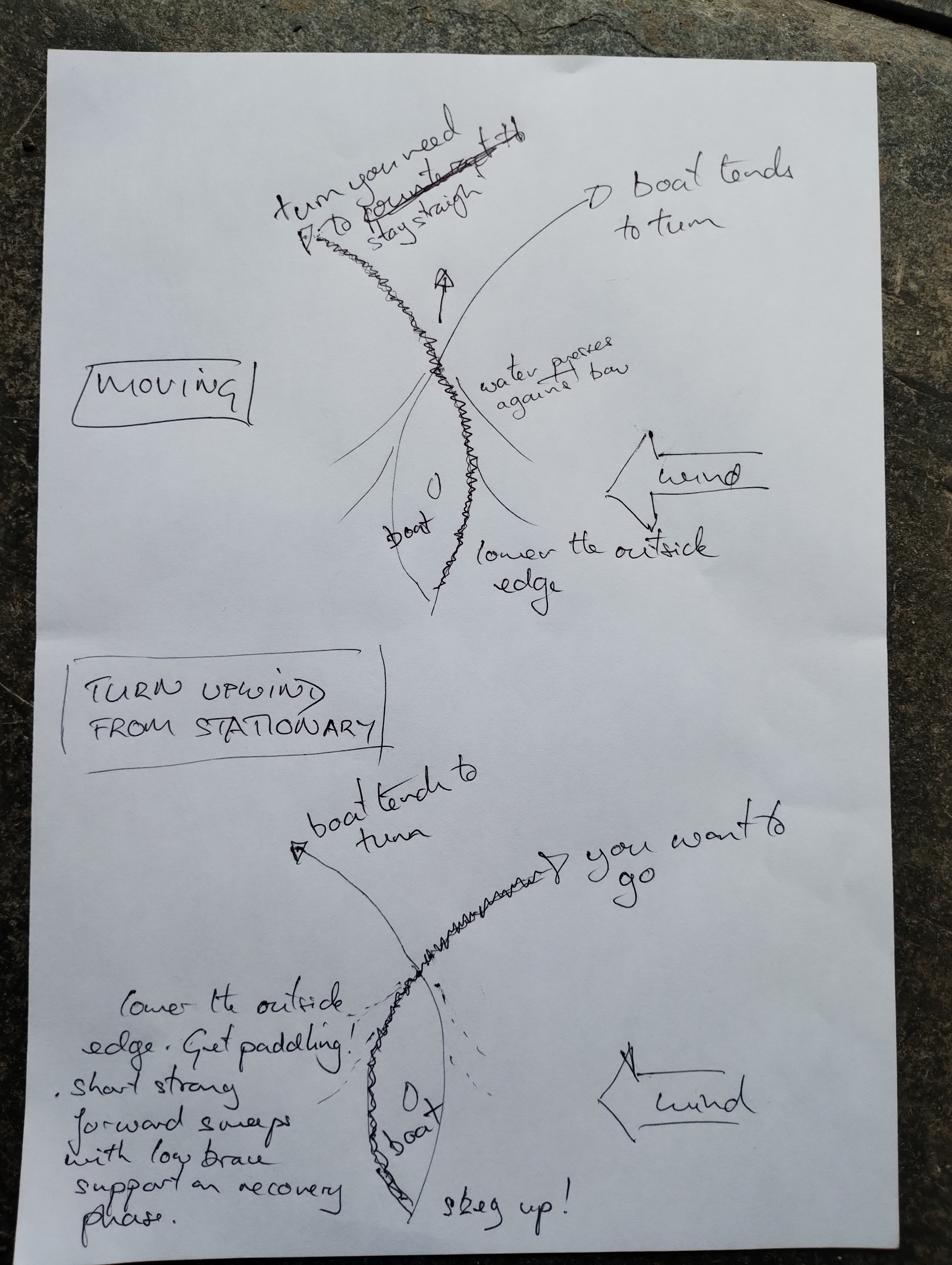
It was a bit windy so we explored how a kayak behaves with a cross wind. Here's a recap of the theory.
When moving with a cross wind, the boat has a tendency to turn up into the wind (called weather cocking). This is because the water being pushed by the wedge of the bow 'grips' the front of the boat. Past the cockpit, the boat narrows again, the water isn't forced against it so much, leaving the stern relatively free to be blown down wind. Overall result - the boat wants to weather cock.
We can counteract this and stay on course and side on to the wind by:
Some skeg tips:
Don't drag a boat down to the water edge by the bow, as this tends to jam up the skeg with pebbles.
Instead, lift and push from the stern, or lift the stern and pull that around to the water and launch backwards. Or carry in pairs.
Once on the water, check your skeg mechanism works. If it's jammed ask a buddy to help you free it.
Many boats will have a string dangling from the skeg to make it easier to release from a jam.
Boats behave differently: the same boat behaves differently with a different load/distribution. And of course the boat will behave differently with different paddlers.
Turning in wind:
It's relatively easy to turn down wind, especially as you slow down from moving.
It's harder to turn up into wind from stationary. But you might need to, for example if the wind is blowing you onto rocks. Here's how.
Thanks for your company these past five weeks. Looking forward to seeing you all on the water again soon.